By Benjamin Nathan, guest contributor
AI-related stocks have driven the stock market to all-time highs, but at the cost of stability. As of April 2026, AI stocks accounted for 45% of the market capitalization of the S&P 500. Driven by current capabilities and future promises of AI models, data center buildouts, and extreme capital expenditures, AI companies have dominated global financial markets in recent history.
In the past year Taiwan’s stock market capitalization has grown nearly 70% to over $5 trillion, surpassing the United Kingdom, South Korea, and India to become the world’s 4th most valuable stock exchange. Almost half of the exchange’s value, however, is from one firm: Taiwanese Semiconductor Manufacturing Company (TSMC), a chip manufacturer vital to AI hardware. KOSPI, the Korean stock market, has become a proxy for investors’ views of massive AI infrastructure spending. Fueled by AI leaders SK Hynix and Samsung, the Korean stock exchange has grown more than 185% since the beginning of 2025. However, recent negative consumer sentiment has punished the market, down nearly a fifth this month and more than 40% off its record high in June. The Magnificent 7, a group of U.S. large-cap stocks—Alphabet, Amazon, Apple, Meta Platforms, Microsoft, Nvidia, and Tesla—represent about 34% of the S&P 500’s $70 trillion capitalization.
Such extreme concentration in the entire market amongst a handful of firms in the same sector induces the market to succeed when AI companies succeed and waver as AI wavers. This can create extreme exposure for the broader market to AI volatility.
The two leading AI companies, OpenAI and Anthropic, have yet to go public (Anthropic officially filed for IPO on October 26th) but wield great influence over consumer sentiment. When OpenAI revealed its annualized revenue was about $20 billion less than previously reported earlier this month, markets were sent into a panic. The tech-focused Nasdaq 100 ended down 1.4% following the news due to a large sell-off of AI-linked stocks such as Nvidia and Oracle.
These chain reactions occur, at least partly, as a result of the AI market’s interconnectedness. A recent study from the Bank of International Settlements found between 2021 and 2025, “55.2% of incoming investments in AI firms came from other AI firms.” Much of this investment is for compute and infrastructure—critical inputs for AI that force firms to depend on each other. This pattern of circular investment creates macroeconomic risk; for example, if Nvidia (manufacturer of hardware necessary for AI) invests in Anthropic, which requires Nvidia technology to operate its AI model Claude, Nvidia’s revenue growth will partially reflect its own capital investment into Anthropic rather than organic demand. This offshoot of circular investment muddies the waters for institutions and investors to determine what part of the AI boom is organic demand from consumers and what is revenue generated solely through investment from AI companies to each other. Additionally, when an investor in a firm is also a supplier, it exposes the investor twice to customer shocks of the firm they’re invested in, amplifying the effect across the market.
Investors across the market are becoming wary of a potential unraveling of the AI boom. Markets for Credit Default Swaps (CDS), an insurance-like financial tool that pays out if the company they are linked to defaults on its debt, have soared. Credit Default Swaps against Meta, Nvidia, Amazon, and Alphabet have reached all time high prices, and CDS prices for CoreWeave and SpaceX have doubled in cost since the start of the year.
The sky-high demand for Credit Default Swaps tied to AI companies indicates that investors are worried about the interconnectedness of the AI industry, which could unravel at a rapid pace should there be a major shock, and that they are nervous about the amount of debt these companies have issued in order to finance compute and data centers. Simultaneously, as the stock market has become extremely volatile in large part due to both public and private AI firms, investors are feeling increasingly uneasy about a market downturn rooted in these same ultra-leveraged and entwined companies.
Historically, dividend investing and reinvesting is a reliable engine for long-term portfolio growth. Since 1926, dividends have made up about 4% of the stock market’s 10% average annualized returns.
While it may not provide attractive results in the short term, especially in comparison to hyper-volatile AI stocks, dividend reinvesting can create a compounding effect for one’s portfolio with the potential to deliver stable, long-term growth.
Dividends are also often shielded from market downturns, for they’re paid out from retained earnings, and typically only see cuts from structural losses as opposed to cyclical losses. Firms are incentivized to hold dividends steady during market recessions, signaling to investors transparency and strength during unsteady periods to instill confidence in investors.
There are multiple effective strategies one can undertake when constructing a dividend reinvestment portfolio. For instant diversification and ease, investing in a global ETF such as the FTSE All-World High Dividend Yield Index is an inviting option. An index like the FTSE All-World relieves investors of the possibility of investing in a value trap, a stock that appears cheap according to traditional valuation metrics (like the P/E ratio) but for which the price continues to drop because of structural issues in the business.
Value trap firms will, on occasion, raise their dividend yield to make the company appear attractive to investors who are looking purely for high dividend returns. Dividend-focused ETFs avoid highly volatile stocks in favor of mature dividend payers across global markets, which have proven they can afford their dividend year in and out.
Vanguard FTSE All-World High Dividend Yield UCITS ETF dividends over the last two years
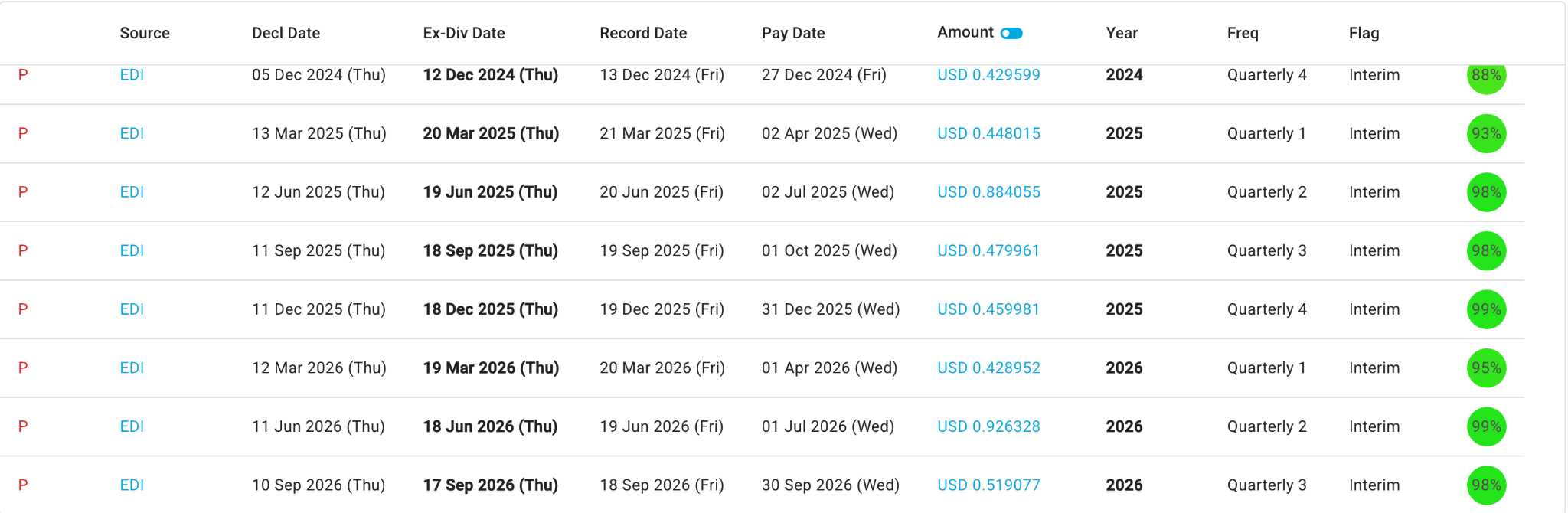
Source: OptionMetrics – Woodseer Dividend Forecast Data
Investors can opt to do the legwork themselves, searching for stable dividend-paying stocks that can deliver long-term compounded returns. Examples include Coca-Cola, Johnson & Johnson, and Lowe’s. Each of these companies have established and predictable revenue sources and have increased dividends every year for over 60 years. They hold dominant market positions in sectors with high barriers to entry and tend to not see extreme day-to-day price variances, unlike AI hyperscalers and related firms.
Coca-Cola dividends over the last year
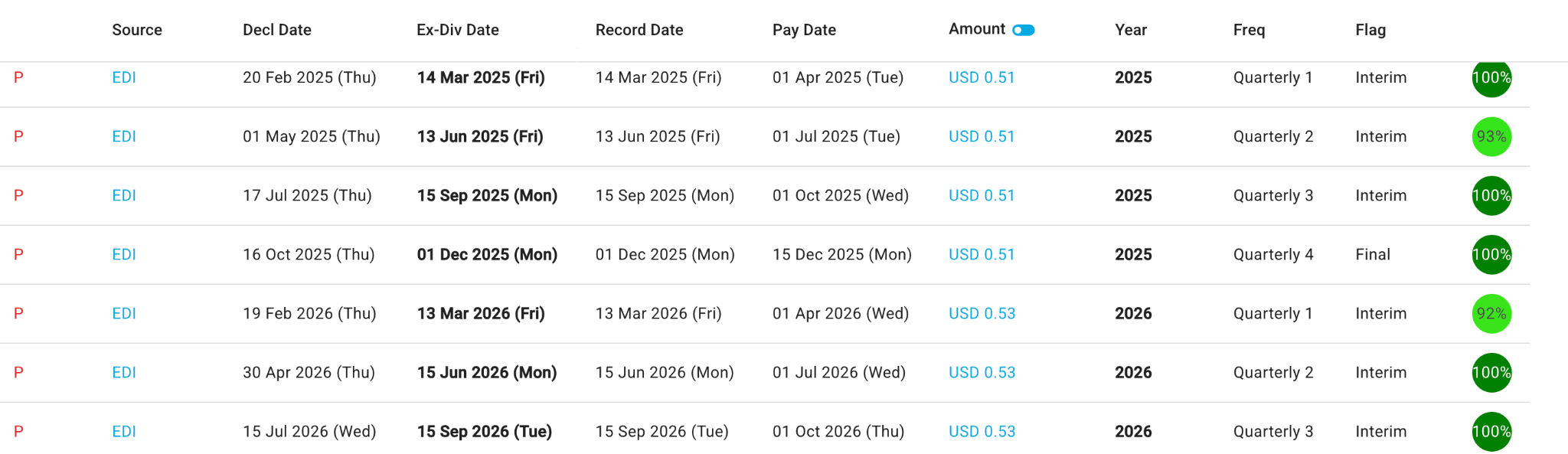
Source: OptionMetrics – Woodseer Dividend Forecast Data
It appears, now, the stock market increasingly lives and breathes with the performance of AI businesses. Each new earnings report, large language model development, or even quotes from CEOs have the potential to generate hundreds of billions of dollars in returns or losses every day. Bolstering one’s portfolio with dividend-paying stocks and reinvesting the dividends when possible could potentially provide greater stability and predictability, which seems harder to come by in the contemporary marketplace.
Written by Benjamin Nathan. Benjamin is a student at Colgate University.
The views and opinions expressed in this article are solely those of the author and do not necessarily reflect those of OptionMetrics. This article is provided for informational and educational purposes only and does not constitute investment advice or a recommendation to buy, sell, or hold any security. Past performance is not indicative of future results, and dividend payments are not guaranteed.